Showing posts with label MiG. Show all posts

Friday, 17 April 2009

Kill ratio of US fighter against MiG

http://www.airpower.maxwell.af.mil/airchronicles/aureview/1984/jan-feb/strode.html#strode

ADVANCED American fighters have confronted inferior Soviet aircraft on several occasions, and it is instructive to examine the results. In the MiG Alley of Korea, the F-86 Sabre was pitted against the MiG-15 deep over hostile territory, a condition that favored the North Korean, Chinese, and Soviet pilots. Yet the American aircraft--larger, more complex; indeed, the most expensive fighter the United States had yet built--achieved a remarkable kill-ratio against its Soviet opposite and thus proved to be clearly cost-effective. But the results of more recent battles have been more ambiguous. The currently deployed F-4 Phantom and MiG-21, for example, have met over both Vietnam and the Middle East, and while the American plane again proved to be the better fighter, its margin of superiority was not always so great as to justify its cost in the unequivocal manner of the F-86. The exact combat ratio between the F-4 and MiG-21 in the Vietnam War remains classified, but William White of the Brookings Institution has estimated it to be about 2: or 3:1 in favor of the Phantom. During one short period for which data are available, the summer of 1972, air-to-air combat resulted in the loss of 12 MiG-21s, 4 MiG-17/19s, and 11 F-4s, yielding a kill-ratio of about 1.5 MiGs for every Phantom shot down.7 In the October 1973 War, Israel's 550 combat aircraft--127 of which were F-4 Phantoms--were highly effective in air-to-air combat against Soviet-built MiGs but proved vulnerable to the Egyptian Army's surface-to-air missiles (SAMs).8

Where national security is at stake, cost-efficiency analyses alone are hardly persuasive, and it must again be stressed that the F-4 did win the battle for the sky in both Vietnam and the Middle East. But to the extent that cost-efficiency criteria are valid considerations in determining force structure, the F-4's performance might be seen as somewhat disappointing. Almost three times as heavy as the MiG-21 and with a 38 percent greater combat radius, it costs about three times more to produce when measured in dollar terms.9 But is it three times more effective, or do technological improvements at some point become subject to diminishing returns?

Critics of current U.S. force structure believe the latter to be the case and contend that saving could be realized without significant loss of combat effectiveness by limiting the missions and capabilities of tactical aircraft. Proponents of this policy frequently look to the Soviet Union for an example of an alternative procurement policy, claiming that the U.S.S.R. has secured its defense at lower cost by restricting its tactical air forces to air superiority and ground-attack missions, with little regard to interdiction; by building simple, mission-specific aircraft rather than MRCAS; and by resisting the temptation always to push technology to the limit when designing new aircraft, opting instead for quantity over quality. A closer inspection, however, reveals this analysis to be seriously flawed. In the first place, it is not at all clear that Soviet tactical air forces truly "cost less" than their American counterparts. Second, the argument confuses past capabilities with current policy and then unjustifiably projects that policy into the future. The purpose here is to provide a more accurate understanding of Soviet design policy and suggest the implications that that policy holds for future combat aircraft production.

Missions, Performance, and Design

It is true that the U.S.S.R.'s Frontal Aviation forces have generally not undertaken deep interdiction missions and that the service's aircraft are primarily designed for air superiority or ground attack. They are also more mission-specific than the major U.S. fighters. The MiG-21 and -27 are designed for air superiority; the Su-7 and -17 for close support; and the Su-24 for penetrating ground attack against hardened targets. Within Voiska PVO, too, aircraft are designed for specific, limited roles. Pilot training, for example, concentrates on ground control interception, not free air combat, and the MiG-25, while performing high-altitude, highs-peed interception ably, is far less capable in other roles. The Su-9 was designed as a point defense interceptor; the Yak-28, as a low-altitude interceptor. The Tu-28 was built specifically for long-range intercepton.10 None possess the multirole capabilities of U.S. fighters.

It is also true that Soviet aircraft do not exhibit the same level of technology as U.S. aircraft. But one should not underestimate Soviet equipment, for in some areas it performs very well. The U.S.S.R.'s electro-optical and laser systems are highly capable, as are its ECM and infrared equipment. But overall, Soviet designers do not build into their aircraft the high-performance characteristics typical of U.S. forces. Their onboard computers are less sophisticated, and they fall far short of the United States in the use of composites and miniaturized avionics.11 Indeed, the MiG-25 in which Lieutenant Viktor Belenko defected in September 1976 did not even make extensive use of advanced metals. The aircraft was constructed primarily of steel, with titanium found only in structures subject to extreme heating, such as the wing leading edges. The resultant weight penalty reduced the amount of equipment that could be carried, and this constraint was still further exacerbated by the aircraft's use of vacuum tubes rather than solid-state circuiting in its electronics. A comparative examination of climb, acceleration, turn radius, and radar capability reveals the superiority of the F-15 and F-16 to late-model MiG-21s and the MiG-25, and even the older F-4 compares not unfavorably.12

Underlying the differences between U.S. and Soviet aircraft are divergent approaches to aircraft design. The United States has emphasized complexity, versatility, and technological sophistication and has been willing to sacrifice a certain amount of quantity in exchange for higher quality. Within the Soviet Union, however, radically different practices were fostered among the research and development (R&D) community during Stalin's rule and have remained persistent features of Soviet design policy to this day. The five most prominent of these recurrent patterns are simplicity, commonality, prototype modeling, incrementalism, and reliance on foreign technology.

The simplicity of Soviet designs relates to their modest performance specifications, just sufficient to allow completion of the minimum tasks required and no more. Simplicity is evident in the designs as a whole, in the utilization of conventional, readily available construction materials, and in the lack of detailed finishing. Commonality refers to the use of standardized parts and assemblies on various types of aircraft whenever possible. Alternatively, an entire aircraft series, on reaching obsolescence in its original role, may be modified to fulfill some new system requirement. (This is not, however, the multirole principle found in NATO designs, in that Soviet aircraft have usually not been designed with more than one function in mind. It is only after an aircraft can no longer perform the specific mission for which it was originally created, or when an unforeseen requirement has arisen for which no aircraft yet exists, that an attempt is made to find a new use for the older series.) The ASh-82 engine, for example, was used to outfit the World War II-vintage La-5 fighter, the Tu-2 frontal bomber, and the Pe-8 long-range bomber. Indeed, twenty years later it was still in service on the I1-14 passenger carrier and the Mi-4 helicopter.13 Similarly, the Su-7 ground-attack fighter and the Su-9 interceptor, although fitted with different wings, armament, and equipment to suit their particular roles, nevertheless possess identical fuselages and tails.14 To take another example in a somewhat different vein, the M-4 Bison, though currently being phased out of its bomber role, is being modified to serve as a tanker, and a version of the old Tu-95 Bear has been developed to operate in an antisubmarine warfare capacity.15

The third feature of the U.S.S.R.'s design process, prototype modeling, specifies the purpose to which research, development, testing, and evaluation are being directed. In the Soviet Union, newly designed aircraft fall into two categories, "test" (opytnye) and "experimental" (eksperimental'nye). Test models are designed to serve as prototypes of forthcoming series production aircraft, and the emphasis is placed on feasibility and existing technologies. Experimental aircraft, on the other hand, are not intended for series production but are built to test a particular new technology or flight characteristic--record-breaking speed, new maneuvers, a new design principle, etc.16 Prototype modeling, then, provides a link between the static traits of Soviet design policy (simplicity and commonality in series production aircraft) and the dynamic features that foster innovation (incrementalism and foreign input).

The conservatism of Soviet aircraft design policy is nowhere better exemplified than in its stress on innovation through incremental improvement. The approach blends well with the nation's predilection for commonality, since when only modest, step-by-step changes are introduced to upgrade performance, follow-on aircraft are left with many of the same features as their predecessors. While experimental prototypes (I and Ye series) occasionally introduce major improvements in technology, the predominant pattern has been gradual upgrading. Even what appear to be discontinuous advances in the performance characteristics of deployed aircraft have, in fact, been achieved little by little through prototype testing. The transition from the MiG-19 to the delta-wing MiG-21, for example, involved five intervening prototypes: (1) the Ye-50, a sweptwing aircraft with an upgraded MiG-19 engine; (2) the Ye-2A, a sweptwing model equipped with the future MiG-21 production engine; (3) the Ye-5, a deltawing prototype with the same fuselage and engine as the Ye-2A; (4) the Ye-6, a preproduction series very similar to the Ye-5; and, finally, (5) the production version, the MiG-21F/Fishbed-C. This model itself has undergone extensive upgrading since its introduction in 1960, so that the most recent version has twice the range and payload of the original.17

The other major avenue to qualitative improvement employed by the Soviets is to borrow from Western technology and experience. Numerous examples could be given, from the jet engine to integrated circuitry. Such innovation may take the form of partial borrowing or complete replication (bez otsebiatiny). As A. Fedoseev, an applied scientist who recently defected from the Soviet Union, explains: "The themes of new military developments are taken from foreign technical journals and intelligence information on foreign equipment, and often arise as a result of obtaining actual examples of the equipment from abroad."18

Sunday, 7 September 2008

Secret USAF MiG


Secret USAF MiG
THE PHOTOGRAPHS appearing an these pages were once a closely-guarded secret. They show a Soviet-built MiG-21F-13 Fishbed-E jet fighter wearing American insignia and being evaluated by the US Air Force in 1968. At that time, similar MiG-21s were being used to combat US warplanes in Vietnam. For years, rumours persisted that Soviet-bloc warplanes were being secretly tested by the US. In March 1998, three decades after American pilots flew the MiG-21 in US skies, the USAF allowed details - and some pictures - to become public. By then, numerous accounts had appeared in the press. HAVE DOUGHNUT was the USAF project name for its flight test evaluation of the MiG-21 between January 23 and April 8, 1968. At the time, the fighter was the top gun. of the communist world, The spelling Donut (see March 2001, p. 73) was not used. Two more Russian fighters were evaluated soon afterwards, HAVE DRILL was the term for American tests of a slightly older MiG-17F Fresco-C jet fighter (a Polish-assembled LIM-5 serial 1007-18, made largely from Soviet-manufactured components (and wearing bort, or nose, number `055') which took place the following year, between January 27 and June 30, 1969. The USAF simultaneously evaluated a second MiG-17F (serial number not provided, bort number `002') in a concurrent project HAVE FERRY. The MiG-21 and the two MiG-17s were flown extensively by Air Force any navy pilots. The MiG-17s were camouflaged, and the MiG-21 flew in natural finish with the US national insignia on both sides of the nose (but not on the wings) and the number '90865' on the tail. Away from the pubic gaze, the MiG-21 was put through performance and stability tests before being flown against Strategic Air Command B-52 Stratofortress and B-58 Hustler bombers. The aim was to judge the ability of the bombers' defensive systems to detect an aerial foe. Later, the MiG-21 was flown against virtually every US military aircraft then in the inventory, from the Navy's A-7E Corsair II to the Air Force's F-4 Phantom II. The Air Force also carried out radar crosssection and propulsion tests on the MiG-21. Though the Americans had not previously had their hands on a MiG-21, the information gleaned appears not to have surprised anyone. Few surprises Air Force officers concluded in a now-declassified intelligence report that the MiG-21's technology "was in most cases comparable to our own" but that the Soviet fighter was cruder and intended to be built on simpler production lines. For example, the MiG-21 had countersunk rivets protruding as much as an eighth of an inch above the skin of the aircraft. Experts were impressed by the fact that the MiG-21 had smokeless engines, making it - unlike the Phantom II - difficult to detect visually. Many of the report's conclusions, once classified 'secret', make it sound as if the USAF could have saved money by consulting a plastic modeller rather than flying an actual MiG-21. For example: "The design concept which appears to have been used by the Soviets was to 'wrap' the smallest airplane possible around the available powerplant to assure maximum speed, altitude, and acceleration performance. This philosophy was carried to the point where bulges in the fuselage were provided at various places to clear equipment and accessories, rather than permit an overall increase in fuselage diameter or cross-section area. The performance of the MiG-21 attests to this approach." Equally superficial is the report's conclusion, also originally classified 'secret': "By US standards for tactical aircraft, the range and payload capabilities of the MiG-21F-13 are very low, but the Soviets did achieve their apparent goal of developing a rugged, simple, highly realiable [sic] and easily maintained fighter with exceptional climb, altitude acceleration and manoeuvrability capabilities, surpassing any other aircraft operational at the time (early 1960) that it went into service. These characteristics are still very good by present-day tactical fighter standards if range and payload are not a prime concern." Mystery Sabreliner The MiG-21 was also flown against a T-39A Sabreliner equipped with an ATR-1 airborne radiometer (producing a distinctive `hump' atop the fuselage of the T-39A, behind the flight deck). This measured the fighter's vulnerability, or lack of it, to airborne infra-red (IR) weapons by evaluating IR emissions at various angles, speeds, power settings, and altitudes. The radiometer could be adjusted to produce data based on the performance of the principal US air-to-air missiles of the era, the AIM-4C/D Falcon and AIM-9G Sidewinder, as well as the IRSTS (infra-red search and tracking system) employed by some US interceptors such as the F-lOlB/F Voodoo. The MiG-2l-versus-T-39A engagements yielded a wealth of information about how to attack a MiG-21 with an IR weapon, but there were also moments when all did not go well. For example: "Mission No.5 was mainly unproductive because of the everworsening background conditions and the low contrail level. The aircraft were 'sandwiched' between a contrail level at 33,000ft (10,058m) and 30,000ft (9,144m)." Several data runs failed to produce useful information because the data was `influenced by other factors'." Similar IR tests were later conducted between the T-39A and the two MiG-17s. Although the USAF claims the external appearance of the IR test T-39A was never classified, one wonders why no photo of the aircraft appears to have surfaced. Both the MiG-21 and a MiG-17 subsequently flew against a T-39A (59-2871) with a different type of radiometer extending from the starboard side of the fuselage but without the ATR-1 unit's distinctive hump. It is unclear whether these subsequent tests were conducted by the same T-39A, after modifications, or whether the ATR-1-equipped Sabreliner was a different aircraft. The Source? Any reference as to who provided the three MiGs 30 years earlier or where the planes were tested is missing from the papers declassified in 1998. There has been speculation that the MiG-21 was flown to Israel on August 16, 1966, by an Iraqi defector, Captain Monir Radfa. The two MiG-17s were brought to Israel on August 12, 1968, by Syrian 1st Lts Walid Adham and Radfan Rifai, who became disoriented and landed in Israel by mistake. Israel reportedly loaned the MiGs as part of a trade-off for a controversial US decision, taken soon after by the Nixon administration, to supply F-4D Phantom Its (these were later joined by F-4Es) to the Jewish state. Flight testing of the MiGs took place at the US airbase at Groom Lake, Nevada. Built in the 1950s as a test site for the U-2 reconnaissance aircraft, and known then as 'the Ranch', Groom Lake has been closed to press and public ever since. Officials will not discuss the base. This has led to speculation on everything from a super-secret Aurora spy plane to little green aliens kept in bottles neither of which ever existed. Other names for the location, such as 'Area 51', are the work of imaginative sensationalists. The base is part of a vast complex in Nevada which includes the Nellis test range and the National Test Site, the latter term a euphemism for the US nuclear test location. The USAF's position on the source of the MiGs is that "International agreements preclude release of this information." As to where the aircraft were tested, the official USAF position is that they "were examined and tested at secure locations in order to maintain security and secrecy." The tests were the responsibility of the Foreign Technology Division of Air Force Systems Command (AFSC), a predecessor of today's Air Force Materiel Command. The word `Have' in project names such as HAVE DOUGHNUT (MiG-21) Or HAVE BLUE (the prototype for the F117 stealth fighter) simply mark the project as belonging to AFSC. Secret Base As for the secret base at Groom Lake (today serviced by a US government civilian contract 'airline' operating from McCarran airport in Las Vegas), it should be noted that there is almost certainly a great deal less at the base than some fanciful accounts suggest. Although the concept of a 'black programme' did not exist in the 1960s (it came along in the late 1970s with the first efforts at developing stealth aircraft), there was nothing new about the USAF testing a potential foe's aircraft in secret. In the early 1950s, the USAF tested a Yakovlev Yak-23 at Wright-Patterson Air Force Base, Ohio, before packing the fighter into a C-124 Globemaster and returning it to a co-operative owner in Eastern Europe. Tests of the Yak-23 (carried out before the creation of Air Standards Co-ordinating Committee names, which later made the aircraft a Flora) remained secret for more than 40 years after they took place. HAVE DOUGHNUT, HAVE DRILL and HAVE FERRY Must be taken in the context of their times. In the US, conflict between a conservative regime and a growing number of anti-Vietnam protesters had spread from the campuses to the streets, and federal agencies were secretly investigating the loyalty of American citizens - a practice which is now illegal. In the skies of North Vietnam, MiG-17s and MiG-21s (especially the MiG-21s) were performing well against American warplanes. Not long after the MiG-21 and MiG-17 tests in Nevada, the USAF somehow found a way to 'borrow' a MiG-15UTI Midget two-seat trainer and MiG-17 Fresco from the Cambodian Air Force for evaluation. In complete secrecy, the aircraft were flown from Phnom Penh to Phu Cat Air Base, South Vietnam, where they were tested in late 1970. Although the tests were never made public and although they apparently revealed little which had not been learned the previous year at Groom Lake airmen at Phu Cat were able to take snapshots of the MiGs. Testing the MiG Returning to the Nevada tests in 1968 (MiG-21) and 1969 (MiG-17), all three aircraft were put through flight testing. The USAF will not disclose names of pilots or maintainers involved in the MiG tests. Some belonged to the Air Force Flight Test Center (AFFTC). Some of the pilots' comments are thoughtful and sensible - for example: "The cockpit of the aircraft was an antiquated design. It was not possible to enter or exit the cockpit with any degree of urgency. The pilot had to step on the seat type parachute, which was an integral part of the seat. It was then necessary to support himself with his hands on the canopy rails while threading his feet onto the rudder pedal stirrups. It required an average of two minutes to don the parachute harness and hook up the necessary personnel leads after entering the cockpit. The seat was actuated electrically for proper positioning. The rudder pedals were adjusted manually before entering the cockpit. The cockpit was small and it would be difficult for pilots over 6ft (1.8m) tall and well built to fly the aircraft comfortably. The cockpit was approximately the same size as the F-86F (Sabre), with less leg-room." We know from other sources that some of the MiG pilots were USAF Col Robert `Bobby' Bond (who later flew A-7Es in Southeast Asia), Navy Cdr Marland W 'Doc' Townsend (an F-4 Phantom II pilot), Navy Cdr Tom Cassidy (a future admiral), and Navy Cdr Foster S 'Tooter' Teague (who later commanded a carrier air wing in Vietnam). The two MiG-17s flew 198 sorties (usually together) against a variety of US Navy warplanes, ranging from the F-8J Crusader to the A-6A Intruder. Later, separately, they were flown against the USAF F-102A Delta Dagger, F-104A Starfighter, and F-106A Delta Dart. Barely legible photocopies of the MiG17s flying with all of these aircraft appear in the declassified report, but USAF officials say the original photos have been lost over the years. Some of the details of the tests are fairly minuscule: pilots were impressed with the canopy-mounted periscope in the MiG-17 which improves visibility to the rear hemisphere. As for the HAVE DRILL and HAVE FERRY evaluations of two MiG-17s, one might ask why money was spent on testing an aircraft which, even in 1969, was long in the tooth? Indeed, the author of this article was evaluating the MiG-17 fully a decade earlier, albeit without a real aircraft in hand. The report tells us: "Complete volumes of handbooks and specifications were available on the MiG-17 in the intelligence community, but evaluation of the actual aircraft would furnish vital tactical and operational information necessary for the effectiveness and survival of our air warfare teams." The report lists dozens of ways in which the F-4E Phantom (flown against the MiG-17 in 26 sorties) and the F-105D and F-105E Thunderchief (18 sorties) were superior to the Soviet fighter. Later Tests As regards widespread speculation about a secret squadron of MiGs at Groom Lake, operated by the USAF 'Red Hats' unit, no details have been disclosed about post-1969 tests of Soviet aircraft. Published speculation holds that at one time or another, the US had every warplane in the Soviet arsenal in the Nevada desert. Only the existence of at least two MiG-23 Floggers can be confirmed by actual sightings, and speculation may be exaggerated. The 'black programme' begun in the 1970s to gain intelligence by flying additional Soviet-built fighters in the US is reported to have peaked in the late 1980s and ended in the 1990s. On April 26, 1984, Lt Gen Robert M `Bobby' Bond who had flown the `HAVE' MiGs 15 years earlier-was killed in the crash of a MiG-23 Flogger on the Nellis range. This was one of the few occasions on which the USAF could not cover up post-1969 flights of MiGs. Sadly, it was to have been the general's farewell flight, marking the end of a fine career. Instead, it may have marked the beginning of the end of what were now called `black' programmes in the Nevada desert. The highprofile Bond mishap was a MiG accident the US Air Force could ill afford. As for the secrecy, most of it was based on politics rather than real security concerns. Obviously, the Soviets knew what was going on, but the tests of these aircraft were kept secret, primarily to protect the identity (or identities) of the country (countries) which provided the MiGs flown in Nevada. Comments: This story raises a number of questions for contains certain significant inconsistencies, which, nevertheless, does not make it any less interesting. Perhaps it should be mentioned that the Soviet VVS had an opportunity to study a pair of F-14 Tomcats and extensively test them against current Soviet fighters. These tests were not conducted in the middle of a desert, but just outside of Moscow - at the Zhukovsky Flight Test Centre, then known to the American spooks as "Ramenskoye" airbase (because of the Ramenskoye highway passing nearby). No photos or any other official information regarding these tests were ever released, although it is known that the Tomcats came from the only possible source: Iran. It is also known that one Russian organization consistently participated in testing of foreign aircraft and their components - the Central Aerohydrodynamic Institute, known by its Russian abbreviation "TsAGI" (www.tsagi.ru). Among the aircraft tested at this facility were the two F-86 Sabres captured by the VVS in Korea and numerous other foreign aircraft obtained during various local conflicts, in particular during the Korean and Vietnam wars, as well as reconnaissance aircraft shot down over or near the USSR. Another organization to frequently participate in this research was the Moscow Aviation Institute or MAI (www.mai.ru).

Tuesday, 30 October 2007

Development of MiG 17

http://aviaros.narod.ru/mig-17.htm
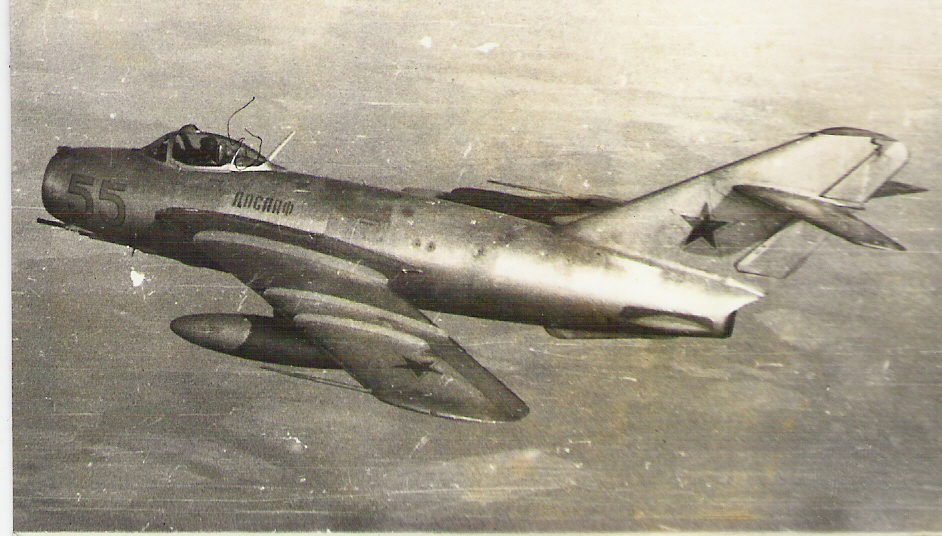
In 1948 in OKB -155 of a.I.Mikoyana was developed the successful destroyer MiG-15, which was produced in large quantities (only in THE USSR at 9 plants). At the proposal I.V.Stalina during this period of work on the creation of the new types of destroyers were convoluted and all efforts were concentrated on further improvement MiG-15. For the purpose of an improvement in the technical flight characteristics in OKB -155 began the work on the equipment of aircraft with new wing with the increased sweepback. At that time to THE USSR several scientific orgnizatsiy conducted the studies of the properties of wing with the sweep angle of 45° according to quarter-chord line, whose application promised essential addition to the speed. Wing was tested in the wind tunnel OF TSAGI - CENTRAL INSTITUTE OF AEROHYDRODYNAMICS IM. N YE ZHUKOVSKIY, on the flying models and the experimental aircraft Of s.A.Lavochkina and M.R.Bisnovata. With the creation of the destroyer, which received designation I -330, it was decided to preserve fuselage MiG-15bis and mate to it new wing. For retaining the centering the wing was executed with the dual sweepback: from the root to the middle of spread of 45°, and it is further - 42° (along quarter-chord line). For an increase in the lift-drag ratio the endings are executed rounded. On the upper surface of consoles it is added on one boundary layer fence. Wing chord ratio is reduced and is improved its joining with the fuselage. The development of aircraft in two versions simultaneously was conducted: tactical fighter and interceptor, but priority returned to the first. The production of the first prototype OF SI was finished during July 1949. After a number of the modifications, which were being continued several months, aircraft of byd it is transmitted to the plant tests. On 14 January, 1950, test pilot OKB -155 Hero of the Soviet Union I.T.Ivashchenko for the first time raised him into the sky from the airfield OF LEAHS in Zhukovskiy. 1 fevral.z on SI at a height 10200 m was achieved the speed of sound. After loss Ivashchenko and the prototype OF SI in the catastrophe on 17 March the tests were continued By g.A.Serovym on the prototype SI -2. The flutter of the tail assembly and the reverse of ailerons were revealed during the tests at high speed. Tests were interrupted for conducting the modifications of construction. In 1951 in Gor'kiy at the plant of №2y were prepared 2 additional prototypes, on which were continued the plant tests. During April 1951 the prototype OF SI -02 was transmitted in the GK NII VVS - State Red Banner Scientific Testing Institute of the Air Force for conducting official tests. It was noted according to the results of tests, that the aircraft with the new wing possesses higher speed and skoropod"emnos'yu, best maneuverability at a high altitude. In this case the maneuverability at the low altitude and takeoff and landing characteristics somewhat deteriorated. After introduction in the construction of a number of modifications the aircraft was rekomendovan into the series production. Initially was assumed production at the plant of №292 in Saratov. But by the order MAP of №8shchy of 1 September, 1951, aircraft under the designation MiG-17 was neglected into the production at the plants of №2y (Gor'kiy), №y (Kuybyshev), №ey (Tbilisi), №yshche (Novosibirsk) and №y2' (Komsomol'sk-on- Amur). It is for the first time demonstrated to the public on 20 June, 1953, at the air display in Tushino. MiG-17 it is built according to the aerodynamic configuration of midwing monoplane. Construction is all-metal (in basic from duralumin D16- T, the separate knots made of steel E0KHGSA). Fuselage is cigar-shaped of round cross section of the type semi-monocoque. Wing is arrow-shaped (45° along quarter-chord line in the root 42° in the end). The high-lift device of wing consisted of the extension flaps and ailerons. The trim tab is established on the left aileron. For increasing the directional stability on the upper wing surface the boundary layer fences are established (3 on each console). In the tail section of ustanavleny speed brakes. Stabilizer had a sweepback of 45°, a keel - shchshch°yay '. Small false keel is established under the aft fuselage section for the best directional stability. Chassis is tripod with the nose steadfast. Power plant consisted of TRD - TURBOJET ENGINE VK -1 (VK -1A, VK -1F). Air duct of frontal with 2 channels, which envelope cab. The tail end of the fuselage was taken apart for the access to the engine with the maintenance on the earth. Airtight cockpit was equipped with the system of heating and with catapult armchair. For an increase in the flying range under the wing could be hung up by 2 PTB on 400 or 600 l. on the interceptors in the forward fuselage it was established RLS. The composition of armament changed depending on modification and were included guns N -37 (N -37D), NR -30, NR -23, rockets RS -1U (K -5), RES (K -13), S -21, free-falling bombs by caliber to 250 kg. MiG-17 entered into service it was regimental VVS, PVO - AIR DEFENSE and VMF, it were exploited in the aero clubs OF DOSAAF - ALL-UNION VOLUNTARY SOCIETY FOR ASSISTANCE TO THE ARMY, AIR FORCE, AND NAVY. The retraining of pilots, those previously flown on MiG-15, passed without the problems. Like predecessor, MiG-17 was characterized by simplicity of control and it was accessible to the pilots of average qualification. In the operation the aircraft appeared itself by very reliable and simple in the maintenance, and the reliability of its engine became simply legendary (VK -1 maintained the entry of birds and foreign objects). In the 50- years MiG-17 it was the basis of Soviet fighter aircraft. It participated in many large military maneuvers (in such cases with the application of nuclear weapons on The totskom range on 14 September, 1954), in the Hungarian and Czechoslovak events. Interceptors MiG-17P/PF repeatedly intercepted intruders and razvedivatel'nye sounding balloons. The first air victory on MiG-17 was gained on 29 July, 1953, when the pair of aircraft of 88 gviap VVS KTOF intercepted above the Ussuri molded edge and brought down the American intelligence officer Rb -50. since 1960 of shelf on MiG-17 they began to be transferred to the newly organized fighter-bomber aviation. Longer anything Soviet MiG-17 were exploited in Armavirskom VVAUL PVO - AIR DEFENSE - up to 1977. In the line units some aircraft served even prior to the beginning of the 80th it was annual. Some MiG-17 with the taken armament were transmitted to the training centers OF DOSAAF - ALL-UNION VOLUNTARY SOCIETY FOR ASSISTANCE TO THE ARMY, AIR FORCE, AND NAVY. Many aircraft at the end of the period of service were re-equipped into the radio-controlled targets. Series production continued up to 1958. In all at five plants are prepared 8085 aircraft MiG-17 all modifications. After appearance MiG-19 it were constructed only for the export. It were let out on license in China (1828 aircraft) and Poland (540). Production in Czechoslovakia was planned. It were supplied in the export into Albania, Algeria, Angola, Afghanistan, Bangladesh, Bulgaria, Hungary, Vietnam, Guinea, Guinea- Bisau, GDR, Egypt, Zambia, Zimbabwe, India, Indonesia, Iraq, Yemen, Kampuchea, China, PDRK - PEOPLE'S DEMOCRATIC REPUBLIC OF KOREA, Congo, Cuba, Madagascar, Malagasy republic, Mali, Morocco, Mozambique, Mongolia, PDRY - PEOPLE'S DEMOCRATIC REPUBLIC OF YEMEN, Nigeria, Pakistan, Poland, Rumania, Syria, Somalia, Sudan, USA, Tanzania, Uganda, Finland, Czechoslovakia, Shri-Lanku, Yugoslavia. In the process of production constantly it were modernized: fuel system was finished, form and area of speed brakes changed, catapult armchair with the shutter and changed movable part of the lamp was established from the end of 1953, the content of equipment and armament changed. MiG-17 and J -5 (F -5) participated in the numerous local conflicts: Arabo-Isreali wars, in Vietnam, Afghanistan, to the West Sahara, Burkina- front, Iran- Iraqi, ugandiЯko- Tanzanian, Ethiopian- Somali wars, Civil Wars in South Yemen, Angola, Nigeria, Mozambique, etc. In some camps of the third peace MiG-17 it continues to remain in arsenal and now. At present MiG-17 it is the exhibit of museum VVS into Monino, MiG-17M - museum VVS of northern fleet. Several aircraft are used as the teaching aids in military and civil aviation VUZ - Institute of Higher Education.

Monday, 15 October 2007

Have drill & Have ferry & Have doughnut

DETAILED THREAT KNOWLEDGE

The heritage of Foreign Materiel Exploitation
1945 - Exploiting The ME-262
The Problem with the Russians

A Dream Come True
MiG-15bis Flown by No Kum Sok defected on 21 September 1953
Most important technical intelligence of the 1950s: Validated our methods

Testing the MiG-15
§MiG-15 flown at Wright Patterson, Eglin,
PAX River
§ Flew against B-47, B-36, F-84 and F-86

1969: The MiG-17F’s Turn

What We Had
HAVE DRILL
Instrumented
Periscope
SCAN FIX radar
172 sorties
HAVE FERRY
Back-up A/C
No Periscope
No radar
52 Sorties


U.S. Test Equipment
AFFTC personnel replaced the clock, airspeed indicator,
altimeter, and accelerometer, plus installed a machmeter
-Installed voice tape recorder in cockpit and photo recorder
for instruments in the nose compartment
-14-channel oscillograph mounted in gun platform where
ammo boxes were. It weighed 75 pounds
-Recorded fuel flow/temp, OAT, engine RPM, airspeed/altitude,
control surface positions, attitude, roll-pitch-yaw rates,
accelleration and the EVENT button


MiG-17 Cockpit Modifications

G meter
Intervalometer
Airspeed
Altimeter
Machmeter
EGT/Tach
Tape recorder
UHF radio
OSC/Event


U.S. Test Equipment
AFFTC personnel replaced the clock, airspeed indicator,
altimeter, and accelerometer, plus installed a machmeter
-Installed voice tape recorder in cockpit and photo recorder
for instruments in the nose compartment
-14-channel oscillograph mounted in gun platform where
ammo boxes were. It weighed 75 pounds
-Recorded fuel flow/temp, OAT, engine RPM, airspeed/altitude,
control surface positions, attitude, roll-pitch-yaw rates,
accelleration and the EVENT button


The MiG-17F cockpit

Antiquated design
Cramped for a man
over 6 feet and the seat
was not adjustable
-Excellent periscope


Testing The MiG-17

300-350 KIAS - MiG’s best speed advantage, we couldn’t outturn it
450 KIAS+ Speed is Life
No smoke trail
SCAN FIX lit the AAA warning light
Combat radius –
115nm clean
215nm w/tanks
Aircraft was extremely reliable!! 4-5 sorties a day


37mm/23mm Gun Tests


Don’t Get Hit By Them


Technical Test Lessons Learned
Exploited SRD-1 SCAN FIX, SRO-2 IFF, VHF radio, SIRENA RWR – Learned a Lot!
VK-1F engine
Infrared/Acoustic/Radar Measurements
Vulnerability Study
Hydraulics – Who needs them?
She’s hard to steer – differential braking
375 gallons internal fuel - 20-25 minutes
Hard to see!! Little and clean
Above 375 KIAS – Dutch Roll


HAVE FERRY


Good Stuff to Know
-Above Mach .85 control very heavy (2 hands)…8.0g limit
-In 224 flights, only 23 major discrepancies occurred and only two missions
were lost
-They spun it once (fully developed) during flight test. Spun to the left, full right
rudder did nothing for four turns..popped stick full forward (to white line)
..recovered after 23 seconds/3,000 ft
-Controls did not have pitch, roll, or yaw stability augmentation and only the ailerons were hydraulically boosted. Rudder/elevator manual
-HAVE DRILL was Lim-5 serial number 1C-07-18, built in Poland in 1956-57.
The LIS-5 engine was serial number 559128
Aircraft Arrival First Flight Total sorties
HAVE DRILL 27 Jan 69 17 Feb 69 172/131.3 hrs/55 days
HAVE FERRY 12 Mar 69 9 Apr 69 52/37.7 hrs/20 days
22

Assessment
1968: The Mystery MiG-21
javascript:void(0)
Publish Post

Project HAVE DOUGHNUT

MiG-21 Flight Test

Tuesday, 18 September 2007

MiG-15 and F-86 Sabre Arm

Sabre Arming MiG-15 and F-86 Sabre

F-86 armed with a 12.7 mm machine guns family.

Arming MiG-15 were three guns: one fire 37 mm and two 23 mm and a weight seconds bursts MiG-15 significantly exceeded F-86.
As evidenced by our pilots fighting in Korea [11], arming MiG-15 related to its main advantages

For example, getting a 37-mm shells at the enemy fighter shooting down his guarantee, while documented cases of MiG-15 returned to the airfield with more than a hundred (!) Proboin Seybra of machine guns.