
Showing posts with label MiG 15. Show all posts
Showing posts with label MiG 15. Show all posts
Tuesday, 12 January 2010


Sunday, 9 November 2008
Modifications fighter MiG-15 (1)
Modifications fighter MiG-15 (1)
MiG-15 (JI) - aircraft equipped with sliding installation sight ASP-3N and a new peak with heavy armor. In 1950 passed state tests.
Telescopic sight plant were assessed as a result of violations of the flight navodki first sight.
MiG-15bis (SA-1, SA-2) - destroyer equipped with devices blind landing.
In order to allow flights day and night in simple and complicated meteorological conditions in 1950, two MiG-15bis were equipped with devices blind landing (OSP-48). Subsequently, were equipped with two more vehicles: SA-3 and SA-4. They differ mainly positioning devices in the cockpit. The complete set of equipment OSP-48 consisted of automatic radio ARK-5 "Cupid", the radio marker MRP-48 "Dyatel, radar altimeter low altitude RV-2" Crystal ".
The rear tank of paraffin was replaced by a new, consisting of two distinct halves, between which the power hatch on the lid have been installed units MRP-48 and ABC-5. Camera AFAI-M was removed, along with control panel and electric motor to open stvorok fotolyuchka.
The plane passed state tests, and installation of a blind landing was put into serial production. In addition, in order to expedite the testing of military installations blind landing system that was equipped with 16 aircraft MiG-15, who received military trials with a positive assessment.
To enhance the combat capabilities of aircraft MiG-15bis were working to equip its various outboard weapons.
(1) describe the modification of MiG-15 is not included in the book: Shavrov VB The history of aircraft structures in the Soviet Union 1938 - 1950 estimates. 3rd ed., Corrected. Moscow: Engineering, 1994.
MiG-15bis (SD-21) - airplane, equipped with air jet system AS-21.
In March - April 1952, was remodeled one. Each wing of the console, between the rack chassis and lock suspended the fuel tank was found on one rail on which to strengthen the starting devices PU-21, designed to fire rockets S-21 (ARS-212). Target sight AP-21 provides pritselnuyu firing rockets at a range of 400 to 800 meters and firing artillery weapons - from 180 to 800 m. The sight AP-21 was developed based on the series sight ASP-3NM, while pritselnuyu shooting PU-21 and artillery weapons did not afford (to aim it was necessary to establish a kind of shooting). With the suspension of fuel tanks, rockets could be at the starting devices are suspended, but before firing tanks must be dropped.
31 May, 1952 aircraft was brought to public trials, which passed with positive results. In the combatant forces converted 150 aircraft.
MiG-15bis (SD-5) - aircraft, equipped with two blocks with eight rounds ARS-57 each.
In July 1952, the working drawings were produced and shipped to the plant ╧ 21. Remodeled was one that has passed the test. Is also testing SD-5E aircraft, equipped with two blocks, but with twelve rounds ARS-57 each.
MiG-15bis (SD-10) - the plane with two bombs protivosamoletnymi PROSAB-100. Is for testing 29 February, 1952 a month to test the aircraft was handed over to SD-25 with two PROSAB-250.


 MiG-15bis (Fig. 89) - aircraft equipped with systems "Grad". Protective system "Grad" was intended to raise air minefields in order to defeat compounds bombers or individual aircraft, as well as for violations of building bombers. It was developed in the OKB AS Yakovlev on the tactical and technical requirements of the Air Force ╧ 104, approved in 1952
A fighter MiG-15bis and equipped with a system of "Grad", instead of aerial fuel tanks for the wing suspended two containers with 56 mines each. Container shape and size are similar to the serial podvesnomu fuel Baku, and is divided into seven compartments. The bottom of the container closed two pairs managed stvorok. The forced expulsion of mines of the compartments has pneumatic pusher, which were equipped with all the compartments of the container.
MiG-15bis equipped zagraditelnoy system 'Castle'
Fig. 89. MiG-15bis equipped zagraditelnoy system "Grad"
After the end of 1952, the special flight tests in GK Research Institute of Air Force Two converted at the factory ╧ 1 MiG-15bis (╧ ╧ 135011 and 135039) were returned to EDO to address the identified deficiencies. Factory control tests took place from March 2 to 18 Apr., 1953 tests conducted leading pilot test F.L. Abramov.
Work on "Grad" were terminated in August 1953
MiG-15bis (SD-P) - aircraft, equipped with a braking parachute PT-2165-51 with 15 m2 area of the dome.
In 1951, to explore the possibility of using aircraft MiG-15bis from airfields with limited length of runway, drag chute PT-2165-51 and two versions of braking wheels were fitted with two aircraft available for that purpose military aircraft.
At the bottom of the fuselage between frames 24 and 27 was placed hatch, which placed a special container with a drag chute (TP), exhaust and parachute cord. Container closed doors. TP cable attached to the castle, established in the slot back heel aircraft. Opening locks stvorok during landing and lock anchorage tether TP produced using a pneumatic system. Installing the MC has reduced the mileage of the aircraft twice.
They were tested, and in 1952 the factory ╧ 1 was built small series (10 aircraft).
MiG-15bis (SP-2) (Fig. 90) - fighter-interceptor with a radar station (RLS) Korshun. "
In 1950, MiG-15 was modified by the installation of radar "Korshun" (used for the construction of a new head compartment). However, because of the delay fine-tuning the radar in the NII-17 fighter-interceptor SP-2 under the orders of MAP from 11 Aug., 1951 was converted under the wing angle strelovidnosti 45 ╟, becoming a MiG-17, which in the future and must be tested station Korshun ".
MiG-15bis (SJ) - with fighter wing design VP Yatsenko.
In order to eliminate "valezhki (spontaneous rolling off) aircraft at the factory ╧ 1 in 1952 have been developed, tested and put into production new wings increased rigidity of the VP Yatsenko. In March of that test in GK Research Institute of the Air Force new wing aircraft were equipped with three MiG-15bis.
 MiG-15bis (Fig. 91) - aircraft equipped with a system in-flight refueling tanker aircraft from the Tu-4.
The system was developed in refueling LII MAP. In May 1952, the factory ╧ 153 have been converted, two MiG-15bis allocated for this purpose military aircraft. In 1953, began flight tests of refueling. Actively participate in the testing and refinement took engineers VY Euphorbia and SN Rybakov, as well as pilots test PI Kazmin, SF Mashkovsky and L. B. Chistyakov.
Fighter-interceptor SP-2 radar 'Korshun'
Fig. 90. Fighter-interceptor SP-2 radar "Korshun"
Fighter MiG-15bis, a system equipped with refueling in flight
Fig. 91. Fighter MiG-15bis, a system equipped with refueling in flight
When creating and testing system was resolved several issues related to sustainable system hose - cone "in the flow and choice of its parameters, as well as the technique worked piloting fighter MiG-15bis in the contact and refueling tankers. Refueled by means of two hoses with cones produced from zakontsovok wing air tankers Tu-4, and fuel rods, installed at the top of the ring intake fighter MiG-15bis.
 MiG-15bis "Burlaki (Fig. 92) - destroyer equipped with the system" Harpoon ". The use of podtsepki and hauling in flight bomber Tu-4 to increase the range fighter.
Develop a system to comply with EDO AS Yakovlev. The system consisted of towing winch with cable and receiver-cone mounted on the Tu-4 in the rear fuselage, and "Harpoon", set in the bow of the aircraft MiG-15bis. Tow cable was manufactured in cone at 80 pm
Fighter MiG-15bis' Burlaki '
Fig. 92. Fighter MiG-15bis "Burlaki"
Management system has a central console, located on the left board in the rear germokabine stern hand Tu-4. Installation of winches and related refining bomber Tu-4 ╧ 221001 were made OKB-30 on the technical conditions of the plant ╧ 115. Further development of fighter aircraft MiG-15bis ╧ 53210408 by installing "Harpoon" has been implemented plant ╧ 115.
"Harpoon" is a pneumatic cylinder rod which, together with the castle providing coupling and uncoupling by the action of compressed air to move. Full length "Harpoon" - 1372 mm, length of the protruding part - 945 mm. Before you start coupling rod lock come from the cylinder. Upon entering the castle "Harpoon" in the slot receiver, Cone was an automatic clutch, and then go inside the cylinder rod.
In connection with the installation of "Harpoon" and equipment for coupling with the MiG-15bis was withdrawn fotokinopulemet S-13. In the forward compartment of Coca optional second battery has been installed 12A-30 and chetyrehlitrovy air balloon, which was included in the network of primary air system.
After the factory flight tests (from 2 February to 26 April 1951) towing system was handed over to GK Research Institute of Air Force flight tests on government. They took place from 28 July to 24 August 1951 and ended with positive results. The system of towing showed robust coupling and uncoupling of aircraft in the air both by day and night, and was recognized as a new promising work of interest to the Air Force (as a possible solution escorting bombers). It was recommended to equip the five mass-produced fighter aircraft MiG-15bis and five bombers Tu-4 towing system for refining its tactical application.
In January 1952, the factory was built ╧ 153 series of five MiG-15bis fighters equipped with "Harpoon". In order to carry out military tests at the plant ╧ 18 have been converted five aircraft buksirovschikov Tu-4. The tests took place from 9 July to 8 September 1952 in the 50 th aeronautical Army Far aviation airport Zyabrovka.
In order to determine the characteristics of technology piloting aircraft MiG-15bis, with "Harpoon", were carried out 12 flights, which showed the normal behavior of the aircraft at high speeds instrument, as well as in carrying out various shapes pilotazha.
The system provides multiple tow coupling and uncoupling MiG-15bis with the Tu-4 and towing fighters from working and engine, consisting of detachment and air squadron trains set for the Tu-4 military orders both by day and night. The fighters, being towed, maneuver bombers are not restricted. In the detachment and air squadrons train can be taken from level flight, climb, lower at speeds of up to 7 m / s and a turn to the lists of up to 10 ... 15 ╟.
Since the Tu-4 bomber was outdated, it was recommended that further work out a system of towing with Tu-16 and Tu-95.
In the development of towing DB-115 has developed a system to refuel fighter aircraft MiG-15bis of the bomber Tu-4 with the automatic.
The tests were conducted refueling system manufacturer ╧ 115 in conjunction with LII with 24 Sept., 1954 to March 2, 1955 (leading airman SN Anokhin, pilot-test FI Burtsev, commander of TU-4 AA Efimov Engineer Operator AI Vershinin, leading engineers V. Stepanov (from the plant ╧ 115) and BC Elkin (from LII)). When testing the system was tested towing operation of all units, spent hauling method and made operational evaluation of its work. Tests have shown that the system can provide towing in flight at an altitude of 4000 meters refinement associated with the installation of the system, little aggravated flight technical data planes and their piloting complicated.
In 1956 the theme "Burlaki was closed as lost relevance.
MiG-15bis variant fighter-bomber - a serial MiG-15bis ╧ 2815311 equipped at the factory ╧ 21 additional weapons.
The technical documentation has been developed on the basis of the plan development activities for 1958 The aircraft was fitted two beams on the wings of the main pillars of the chassis and suspension bridges fuel tanks (PTB). This would include options for suspension:
* Two blocks ORO-57K with shells S-5K or C-5M (8 each);
* Two bombs caliber from 50 to 250 kg;
* Two launchers ORO-212K with shells S-1of.
In addition, the locks can be PTB are suspended PTB bombs or fire from 50 to 250 kg. Artillery weapons remains unchanged. For all types of weapons used by sight ASP-3N.
Factory flight tests were not conducted. Public flight tests took place from March 4th, 1959 to 30 June 1959, during which time 114 flights have been fulfilled. The aircraft will withstand the test and was recommended as a reference for the upgrading of planes, comprising armed fighter-bombardirovochnoy aviation.
MiG-15bis with increased braking schitkami (S = 0,8 m2) and duplicate management ejection was presented to the state tests 20 Mar., 1952, which successfully passed. Duplicate management and increased brake shields were put into serial production.
In August 1952, was completed installation of panels area 0.9 m2. As a result of factory flight tests found that a further increase in the area of brake panels impractical, as it did not give the desired effect.
MiG-15M (SDM) - radio aircraft target-based fighter aircraft MiG-15bis. The range of heights strikes 8000 ... 13 000 m. The time recruiting the maximum height for the withdrawal of the military course of 17 ... 18 min. The speed in level flight at a maximum altitude of 880 ... 950 km / h. The total duration of the flight 55 minutes.
Outi MiG-15 (ST-2) - sparring fighter, equipped with instruments blind landing (OSP-48).
In connection with the installation of SWAP-48 was shot gun NR-23. The aircraft in 1950 passed state tests, and installation of equipment blind landing was introduced into serial production.
Outi MiG-15 (ST-8) - sparring fighter with a radar RP-1D "Emerald-3" and the sight of ASP-3NM.
In April - May 1954, ST-8 aircraft passed state tests with unsatisfactory results, as well as to the Air Force aircraft was a new requirement to install a second cabin surveillance indicator and sight associated with RLS. Work on the refurbishment of aircraft under a new station EDO began in late 1954, radar Emerald-3 "in contrast to the station" Emerald had two indicator. The plane was tested in 1955
Outi MiG-15 (ST-10) - flight test system for the protection of the pilot's ejection from the lantern for safe escape the aircraft at high speeds.
Outi MiG-15 - aircraft control planes landing target Yak-25MSH.
From 7 to 22 Dec., 1959 and from I January to February 2nd, 1960 conducted flight tests of three remote experimental aircraft target Yak-25MSH with unmanned takeoff and landing, as well as station management embarkation installed on the aircraft MiG-15 UTI ╧ 106216. For testing as a backup switch to a second landing station management (pilot model) fitted to the aircraft ╧ 106220. The equipment of an ╧ 106216 were fired plant ╧ 918, a plane ╧ 106220 - by LII.
Airborne transmission station was carried out series of ground-based transmitting station MRV-2M and installed in a mobile lafete instead of weapons. Transmitting antennas were placed on the inhibitor. The first cabin was changed dashboard: instead of navigation devices and the sight was set sensor commands DK-16rs.
The results of flight tests showed that the aircraft target Yak-25MSH has better combat and tactical performance in comparison with the existing targets, and aircraft management UTI MiG-15 allows you to successfully implement its landing after the assignment.
Modifications MiG-15 fighter produced in large quantities by the manufacturer (see Table 1).
MiG-15 (JI) - aircraft equipped with sliding installation sight ASP-3N and a new peak with heavy armor. In 1950 passed state tests.
Telescopic sight plant were assessed as a result of violations of the flight navodki first sight.
MiG-15bis (SA-1, SA-2) - destroyer equipped with devices blind landing.
In order to allow flights day and night in simple and complicated meteorological conditions in 1950, two MiG-15bis were equipped with devices blind landing (OSP-48). Subsequently, were equipped with two more vehicles: SA-3 and SA-4. They differ mainly positioning devices in the cockpit. The complete set of equipment OSP-48 consisted of automatic radio ARK-5 "Cupid", the radio marker MRP-48 "Dyatel, radar altimeter low altitude RV-2" Crystal ".
The rear tank of paraffin was replaced by a new, consisting of two distinct halves, between which the power hatch on the lid have been installed units MRP-48 and ABC-5. Camera AFAI-M was removed, along with control panel and electric motor to open stvorok fotolyuchka.
The plane passed state tests, and installation of a blind landing was put into serial production. In addition, in order to expedite the testing of military installations blind landing system that was equipped with 16 aircraft MiG-15, who received military trials with a positive assessment.
To enhance the combat capabilities of aircraft MiG-15bis were working to equip its various outboard weapons.
(1) describe the modification of MiG-15 is not included in the book: Shavrov VB The history of aircraft structures in the Soviet Union 1938 - 1950 estimates. 3rd ed., Corrected. Moscow: Engineering, 1994.
MiG-15bis (SD-21) - airplane, equipped with air jet system AS-21.
In March - April 1952, was remodeled one. Each wing of the console, between the rack chassis and lock suspended the fuel tank was found on one rail on which to strengthen the starting devices PU-21, designed to fire rockets S-21 (ARS-212). Target sight AP-21 provides pritselnuyu firing rockets at a range of 400 to 800 meters and firing artillery weapons - from 180 to 800 m. The sight AP-21 was developed based on the series sight ASP-3NM, while pritselnuyu shooting PU-21 and artillery weapons did not afford (to aim it was necessary to establish a kind of shooting). With the suspension of fuel tanks, rockets could be at the starting devices are suspended, but before firing tanks must be dropped.
31 May, 1952 aircraft was brought to public trials, which passed with positive results. In the combatant forces converted 150 aircraft.
MiG-15bis (SD-5) - aircraft, equipped with two blocks with eight rounds ARS-57 each.
In July 1952, the working drawings were produced and shipped to the plant ╧ 21. Remodeled was one that has passed the test. Is also testing SD-5E aircraft, equipped with two blocks, but with twelve rounds ARS-57 each.
MiG-15bis (SD-10) - the plane with two bombs protivosamoletnymi PROSAB-100. Is for testing 29 February, 1952 a month to test the aircraft was handed over to SD-25 with two PROSAB-250.
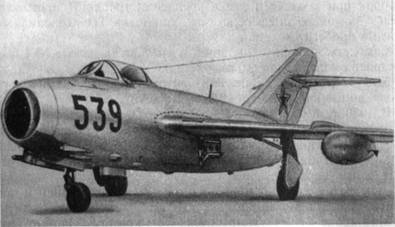 MiG-15bis (Fig. 89) - aircraft equipped with systems "Grad". Protective system "Grad" was intended to raise air minefields in order to defeat compounds bombers or individual aircraft, as well as for violations of building bombers. It was developed in the OKB AS Yakovlev on the tactical and technical requirements of the Air Force ╧ 104, approved in 1952
A fighter MiG-15bis and equipped with a system of "Grad", instead of aerial fuel tanks for the wing suspended two containers with 56 mines each. Container shape and size are similar to the serial podvesnomu fuel Baku, and is divided into seven compartments. The bottom of the container closed two pairs managed stvorok. The forced expulsion of mines of the compartments has pneumatic pusher, which were equipped with all the compartments of the container.
MiG-15bis equipped zagraditelnoy system 'Castle'
Fig. 89. MiG-15bis equipped zagraditelnoy system "Grad"
After the end of 1952, the special flight tests in GK Research Institute of Air Force Two converted at the factory ╧ 1 MiG-15bis (╧ ╧ 135011 and 135039) were returned to EDO to address the identified deficiencies. Factory control tests took place from March 2 to 18 Apr., 1953 tests conducted leading pilot test F.L. Abramov.
Work on "Grad" were terminated in August 1953
MiG-15bis (SD-P) - aircraft, equipped with a braking parachute PT-2165-51 with 15 m2 area of the dome.
In 1951, to explore the possibility of using aircraft MiG-15bis from airfields with limited length of runway, drag chute PT-2165-51 and two versions of braking wheels were fitted with two aircraft available for that purpose military aircraft.
At the bottom of the fuselage between frames 24 and 27 was placed hatch, which placed a special container with a drag chute (TP), exhaust and parachute cord. Container closed doors. TP cable attached to the castle, established in the slot back heel aircraft. Opening locks stvorok during landing and lock anchorage tether TP produced using a pneumatic system. Installing the MC has reduced the mileage of the aircraft twice.
They were tested, and in 1952 the factory ╧ 1 was built small series (10 aircraft).
MiG-15bis (SP-2)
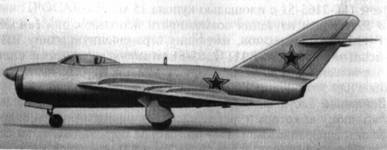 (Fig. 90) - fighter-interceptor with a radar station (RLS) Korshun. "
In 1950, MiG-15 was modified by the installation of radar "Korshun" (used for the construction of a new head compartment). However, because of the delay fine-tuning the radar in the NII-17 fighter-interceptor SP-2 under the orders of MAP from 11 Aug., 1951 was converted under the wing angle strelovidnosti 45 ╟, becoming a MiG-17, which in the future and must be tested station Korshun ".
MiG-15bis (SJ) - with fighter wing design VP Yatsenko.
In order to eliminate "valezhki (spontaneous rolling off) aircraft at the factory ╧ 1 in 1952 have been developed, tested and put into production new wings increased rigidity of the VP Yatsenko. In March of that test in GK Research Institute of the Air Force new wing aircraft were equipped with three MiG-15bis.
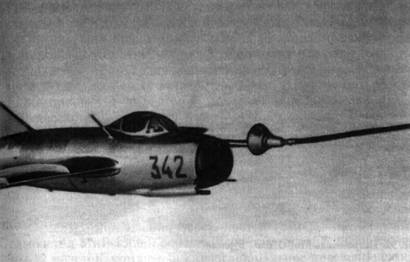 MiG-15bis (Fig. 91) - aircraft equipped with a system in-flight refueling tanker aircraft from the Tu-4.
The system was developed in refueling LII MAP. In May 1952, the factory ╧ 153 have been converted, two MiG-15bis allocated for this purpose military aircraft. In 1953, began flight tests of refueling. Actively participate in the testing and refinement took engineers VY Euphorbia and SN Rybakov, as well as pilots test PI Kazmin, SF Mashkovsky and L. B. Chistyakov.
Fighter-interceptor SP-2 radar 'Korshun'
Fig. 90. Fighter-interceptor SP-2 radar "Korshun"
Fighter MiG-15bis, a system equipped with refueling in flight
Fig. 91. Fighter MiG-15bis, a system equipped with refueling in flight
When creating and testing system was resolved several issues related to sustainable system hose - cone "in the flow and choice of its parameters, as well as the technique worked piloting fighter MiG-15bis in the contact and refueling tankers. Refueled by means of two hoses with cones produced from zakontsovok wing air tankers Tu-4, and fuel rods, installed at the top of the ring intake fighter MiG-15bis.
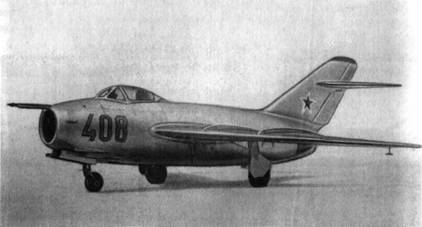 MiG-15bis "Burlaki (Fig. 92) - destroyer equipped with the system" Harpoon ". The use of podtsepki and hauling in flight bomber Tu-4 to increase the range fighter.
Develop a system to comply with EDO AS Yakovlev. The system consisted of towing winch with cable and receiver-cone mounted on the Tu-4 in the rear fuselage, and "Harpoon", set in the bow of the aircraft MiG-15bis. Tow cable was manufactured in cone at 80 pm
Fighter MiG-15bis' Burlaki '
Fig. 92. Fighter MiG-15bis "Burlaki"
Management system has a central console, located on the left board in the rear germokabine stern hand Tu-4. Installation of winches and related refining bomber Tu-4 ╧ 221001 were made OKB-30 on the technical conditions of the plant ╧ 115. Further development of fighter aircraft MiG-15bis ╧ 53210408 by installing "Harpoon" has been implemented plant ╧ 115.
"Harpoon" is a pneumatic cylinder rod which, together with the castle providing coupling and uncoupling by the action of compressed air to move. Full length "Harpoon" - 1372 mm, length of the protruding part - 945 mm. Before you start coupling rod lock come from the cylinder. Upon entering the castle "Harpoon" in the slot receiver, Cone was an automatic clutch, and then go inside the cylinder rod.
In connection with the installation of "Harpoon" and equipment for coupling with the MiG-15bis was withdrawn fotokinopulemet S-13. In the forward compartment of Coca optional second battery has been installed 12A-30 and chetyrehlitrovy air balloon, which was included in the network of primary air system.
After the factory flight tests (from 2 February to 26 April 1951) towing system was handed over to GK Research Institute of Air Force flight tests on government. They took place from 28 July to 24 August 1951 and ended with positive results. The system of towing showed robust coupling and uncoupling of aircraft in the air both by day and night, and was recognized as a new promising work of interest to the Air Force (as a possible solution escorting bombers). It was recommended to equip the five mass-produced fighter aircraft MiG-15bis and five bombers Tu-4 towing system for refining its tactical application.
In January 1952, the factory was built ╧ 153 series of five MiG-15bis fighters equipped with "Harpoon". In order to carry out military tests at the plant ╧ 18 have been converted five aircraft buksirovschikov Tu-4. The tests took place from 9 July to 8 September 1952 in the 50 th aeronautical Army Far aviation airport Zyabrovka.
In order to determine the characteristics of technology piloting aircraft MiG-15bis, with "Harpoon", were carried out 12 flights, which showed the normal behavior of the aircraft at high speeds instrument, as well as in carrying out various shapes pilotazha.
The system provides multiple tow coupling and uncoupling MiG-15bis with the Tu-4 and towing fighters from working and engine, consisting of detachment and air squadron trains set for the Tu-4 military orders both by day and night. The fighters, being towed, maneuver bombers are not restricted. In the detachment and air squadrons train can be taken from level flight, climb, lower at speeds of up to 7 m / s and a turn to the lists of up to 10 ... 15 ╟.
Since the Tu-4 bomber was outdated, it was recommended that further work out a system of towing with Tu-16 and Tu-95.
In the development of towing DB-115 has developed a system to refuel fighter aircraft MiG-15bis of the bomber Tu-4 with the automatic.
The tests were conducted refueling system manufacturer ╧ 115 in conjunction with LII with 24 Sept., 1954 to March 2, 1955 (leading airman SN Anokhin, pilot-test FI Burtsev, commander of TU-4 AA Efimov Engineer Operator AI Vershinin, leading engineers V. Stepanov (from the plant ╧ 115) and BC Elkin (from LII)). When testing the system was tested towing operation of all units, spent hauling method and made operational evaluation of its work. Tests have shown that the system can provide towing in flight at an altitude of 4000 meters refinement associated with the installation of the system, little aggravated flight technical data planes and their piloting complicated.
In 1956 the theme "Burlaki was closed as lost relevance.
MiG-15bis variant fighter-bomber - a serial MiG-15bis ╧ 2815311 equipped at the factory ╧ 21 additional weapons.
The technical documentation has been developed on the basis of the plan development activities for 1958 The aircraft was fitted two beams on the wings of the main pillars of the chassis and suspension bridges fuel tanks (PTB). This would include options for suspension:
* Two blocks ORO-57K with shells S-5K or C-5M (8 each);
* Two bombs caliber from 50 to 250 kg;
* Two launchers ORO-212K with shells S-1of.
In addition, the locks can be PTB are suspended PTB bombs or fire from 50 to 250 kg. Artillery weapons remains unchanged. For all types of weapons used by sight ASP-3N.
Factory flight tests were not conducted. Public flight tests took place from March 4th, 1959 to 30 June 1959, during which time 114 flights have been fulfilled. The aircraft will withstand the test and was recommended as a reference for the upgrading of planes, comprising armed fighter-bombardirovochnoy aviation.
MiG-15bis with increased braking schitkami (S = 0,8 m2) and duplicate management ejection was presented to the state tests 20 Mar., 1952, which successfully passed. Duplicate management and increased brake shields were put into serial production.
In August 1952, was completed installation of panels area 0.9 m2. As a result of factory flight tests found that a further increase in the area of brake panels impractical, as it did not give the desired effect.
MiG-15M (SDM) - radio aircraft target-based fighter aircraft MiG-15bis. The range of heights strikes 8000 ... 13 000 m. The time recruiting the maximum height for the withdrawal of the military course of 17 ... 18 min. The speed in level flight at a maximum altitude of 880 ... 950 km / h. The total duration of the flight 55 minutes.
Outi MiG-15 (ST-2) - sparring fighter, equipped with instruments blind landing (OSP-48).
In connection with the installation of SWAP-48 was shot gun NR-23. The aircraft in 1950 passed state tests, and installation of equipment blind landing was introduced into serial production.
Outi MiG-15 (ST-8) - sparring fighter with a radar RP-1D "Emerald-3" and the sight of ASP-3NM.
In April - May 1954, ST-8 aircraft passed state tests with unsatisfactory results, as well as to the Air Force aircraft was a new requirement to install a second cabin surveillance indicator and sight associated with RLS. Work on the refurbishment of aircraft under a new station EDO began in late 1954, radar Emerald-3 "in contrast to the station" Emerald had two indicator. The plane was tested in 1955
Outi MiG-15 (ST-10) - flight test system for the protection of the pilot's ejection from the lantern for safe escape the aircraft at high speeds.
Outi MiG-15 - aircraft control planes landing target Yak-25MSH.
From 7 to 22 Dec., 1959 and from I January to February 2nd, 1960 conducted flight tests of three remote experimental aircraft target Yak-25MSH with unmanned takeoff and landing, as well as station management embarkation installed on the aircraft MiG-15 UTI ╧ 106216. For testing as a backup switch to a second landing station management (pilot model) fitted to the aircraft ╧ 106220. The equipment of an ╧ 106216 were fired plant ╧ 918, a plane ╧ 106220 - by LII.
Airborne transmission station was carried out series of ground-based transmitting station MRV-2M and installed in a mobile lafete instead of weapons. Transmitting antennas were placed on the inhibitor. The first cabin was changed dashboard: instead of navigation devices and the sight was set sensor commands DK-16rs.
The results of flight tests showed that the aircraft target Yak-25MSH has better combat and tactical performance in comparison with the existing targets, and aircraft management UTI MiG-15 allows you to successfully implement its landing after the assignment.
Modifications MiG-15 fighter produced in large quantities by the manufacturer (see Table 1).
Table 1
| Модификация истребителя Modifying fighter | Завод-изготовитель The manufacturer | Всего самолетов Total aircraft | ||||||||
| ╧1 ╧ 1 | ╧21 ╧ 21 | ╧31 ╧ 31 | ╧99 ╧ 99 | ╧126 ╧ 126 | ╧135 ╧ 135 | ╧153 ╧ 153 | ╧292 ╧ 292 | ╧381 ╧ 381 | ||
| МиГ-15 MiG-15 | 813 | - -- | - -- | - -- | 1 | - -- | 453 | 2 | 75 | 1344 |
| МиГ-15бис MiG-15bis | 1681 | 1784 | 225 | - -- | 832 | - -- | 2420 | 994 | - -- | 7936 |
| МиГ-15Пбис MiG-15Pbis | 5 | - -- | - -- | - -- | - -- | - -- | - -- | - -- | - -- | 5 |
| МиГ-15Рбис MiG-15Rbis | - -- | 364 | - -- | - -- | - -- | - -- | - -- | - -- | - -- | 364 |
| МиГ-15Сбис MiG-15Sbis | - -- | - -- | - -- | - -- | - -- | - -- | - -- | 49 | - -- | 49 |
| УТИ МиГ-15 Outi MiG-15 | 881 | - -- | - -- | 1117 | - -- | 511 | 924 | - -- | - -- | 3433 |
| Все модификации All modifications | 3380 | 2148 | 225 | 1117 | 833 | 511 | 3797 | 1045 | 75 | 13131 |
Wednesday, 22 October 2008


Saturday, 6 September 2008
Friday, 14 March 2008
Monday, 3 March 2008
Sunday, 2 March 2008
Friday, 15 February 2008
米格15航程较短,升空后只能作战30分钟左右
在郑赤鹰所著【我打下了美国飞机-13位中国空军战斗英雄口述实录】中,王海与赵宝桐分别提到米格15航程较短,升空后只能作战30分钟左右。原文如下:
王海访谈节选:“美国飞机腿子长,飞的距离远,苏联不行。苏联是社会主义国家,设计飞机是防空型的,很快起飞,很快下落,又小又少。美国的飞机不一样,因为他的战略决策不一样,他是资本主义,随时要侵略别人,所以他的飞机留空时间长。
抗美援朝的时候,如果敌人起飞一百架飞机,我们得起飞两百架飞机。他们在空中一个钟头,我们只能呆三十分钟,这一百架快没有油,再来一百架对付他。从南朝鲜的飞机到我们驻地,封锁我们起飞降落的,我这个大队牺牲的田宇就是在到了机场要降落的时候,给打下去的。”
赵宝桐访谈节选:“那天您跟这架F-86,跟了多久才把它打下来?
赵宝桐:那也跟了好长时间,十几分钟吧。因为我们飞机出去也就是二十分钟,不能飞太长时间,因为油不够。每一架也就是二十、三十分钟。”
王海访谈节选:“美国飞机腿子长,飞的距离远,苏联不行。苏联是社会主义国家,设计飞机是防空型的,很快起飞,很快下落,又小又少。美国的飞机不一样,因为他的战略决策不一样,他是资本主义,随时要侵略别人,所以他的飞机留空时间长。
抗美援朝的时候,如果敌人起飞一百架飞机,我们得起飞两百架飞机。他们在空中一个钟头,我们只能呆三十分钟,这一百架快没有油,再来一百架对付他。从南朝鲜的飞机到我们驻地,封锁我们起飞降落的,我这个大队牺牲的田宇就是在到了机场要降落的时候,给打下去的。”
赵宝桐访谈节选:“那天您跟这架F-86,跟了多久才把它打下来?
赵宝桐:那也跟了好长时间,十几分钟吧。因为我们飞机出去也就是二十分钟,不能飞太长时间,因为油不够。每一架也就是二十、三十分钟。”
Monday, 24 December 2007
Sunday, 23 December 2007
Tuesday, 18 December 2007
Saturday, 15 December 2007

Friday, 14 December 2007


Saturday, 8 December 2007

Sunday, 11 November 2007

Monday, 29 October 2007

Sunday, 28 October 2007

Saturday, 27 October 2007
Thursday, 25 October 2007
Mikoyan-Gurevich MiG-15(Ji-2)
Mikoyan-Gurevich MiG-15 (Ji-2)
FAGOT B
|
http://www.nasm.si.edu/research/aero/aircraft/mig15.htm
Designed in 1946 to answer Soviet premier Joseph Stalin's urgent call for a high-altitude day interceptor, the MiG-15 was destined to shock the West with its capabilities and make the acronym "MiG" synonymous with "Soviet fighter plane." It was the first Soviet jet to benefit from the British sale to Russia of the new Rolls Royce "Nene" and "Derwent" jet engines. These were immediately copied and refined by the Soviets, and as the RD-500, Klimov RD-45 and modified VK-1, they gave a powerful boost to Soviet jet technology.
First flown on December 30, 1947, the MiG-15 featured the first production swept wing on a Russian aircraft, the first pressurized cockpit, and the first ejection seat. Although Mikoyan and Gurevitch were aware of German turbojet and swept-wing work, this design was wholly Russian--except for the engine. The Cold War had just begun and Stalin was readying the B-29 clone, the Tu-4, and was developing the atomic bomb, both in high-priority programs. MiG-15 production was authorized in March 1948, only 3 months after first test flight, and substantial numbers were in service by the end of 1948 with the both Soviet Air Forces (VVS, the tactical air arm) and IA-PVO (the air defense arm).
Late in 1950, MiG-15s piloted by Russians appeared over North Korea, and their prowess "shocked and stunned" Americans. Their deadly attacks, using one 37mm and two 23mm cannon, quickly ran all piston-engined aircraft from the skies, including the B-29. First generation jets like the F-80 and F-84 were no match, and America had to rush the F-86 into Korea to reestablish air superiority. Despite its high speed, excellent maneuverability, and high service ceiling, the MiG-15 was not very stable as a gun platform, with a tendency to Dutch roll at high speeds because of wing flexing and poor aileron effectiveness. Its cockpit instrumentation was primitive and stick forces were heavy. In combat against the F-86, a much more advanced fighter but with very similar performance, the MiG-15 suffered a 10:1 loss ratio.
Russians were joined by Chinese and North Korean MiG-15s before the Korean War ended, and the MiG-15 was ultimately flown in some 35 countries, remaining in service in China as late as 1978, where it was called the J-2 (F-2 in an export version). The MiG-15UTI trainer version, also used throughout the world, is still in common service today. More than 12,000 MiG-15s were built in 17 versions, in Poland, Czechoslovakia, and China, as well as in the USSR. Many Chinese F-2s have made their way to the United States, where they can be seen in flight displays at air shows. Based on lessons of the Korean combat, the MiG-15 was later upgraded as the MiG-17, which also served throughout the world, including combat in Vietnam and the Middle East.
Subscribe to:
Posts (Atom)